Movie review: Fresh November 3, 2009
Posted by Angelique in Movie reviews.Tags: agriculture, animal ag, animal rights, Animal welfare, Food ethics, movie review, organic
add a comment
The movie Fresh didn’t achieve wide release. That means it relies on volunteers to host screenings and prospective viewers to do a little legwork to find one. As a result, the only people likely to see the movie are those who are already converted to its cause of healthy, local, sustainable food. Accordingly, the screening I attended was patronized by about 200 enthusiasts of all things local and family-farm produced, and was preceded by a light local-food dinner – sustainably-raised pulled chicken sandwiches and 100% grass-fed beef hotdogs.
In a nutshell, Fresh is a celebration of the locavore movement and its heroes. If you’ve read Omnivore’s Dilemma or seen Food, Inc. you won’t find any new facts or surprising revelations in this film, but if you’re a locavore in the mood for a morale-boost (and who isn’t sometimes) you will enjoy it. Extensive interviews with OD author Michael Pollan, sustainable farmer Joel Salatin, and urban farming advocate Will Allen inspire an outpouring of “yes we can” sentiment which doubtlessly everyone sitting with you in the theater will share. Just don’t expect any critical discussion or penetrating analysis of the arguments for and against the movement. That’s OK. It’s not the first movie that asks you to suspend judgment for an hour and a half and just enjoy yourself.
Munching your way to a hotter climate? October 8, 2009
Posted by Angelique in Global warming.Tags: agriculture, animal ag, carbon footprint, climate change, environment, Food ethics, Global warming
5 comments
There’s never any good news about climate change. Not only is it always getting worse – happening faster than we’d thought, wreaking unimagined levels of havoc – but everything we do seems to contribute to it. Why bother changing your light bulbs when your daily commute could illuminate your whole neighborhood? And if you thought driving a car was bad – well, you could drive clear across the planet with the greenhouses gases your Thanksgiving flight home will release. And flying is nothing compared to the damage you’re doing every time you eat a burger!
Reasoning that everything can’t literally be worse than everything else, I did a little research and composed a ranking of our actions’ impact on greenhouse gas emissions, and where meat-eating falls on that list. This ranking is rife with assumptions, but see the chart below for my best shot at the average person’s annual CO2 emissions from various sources.
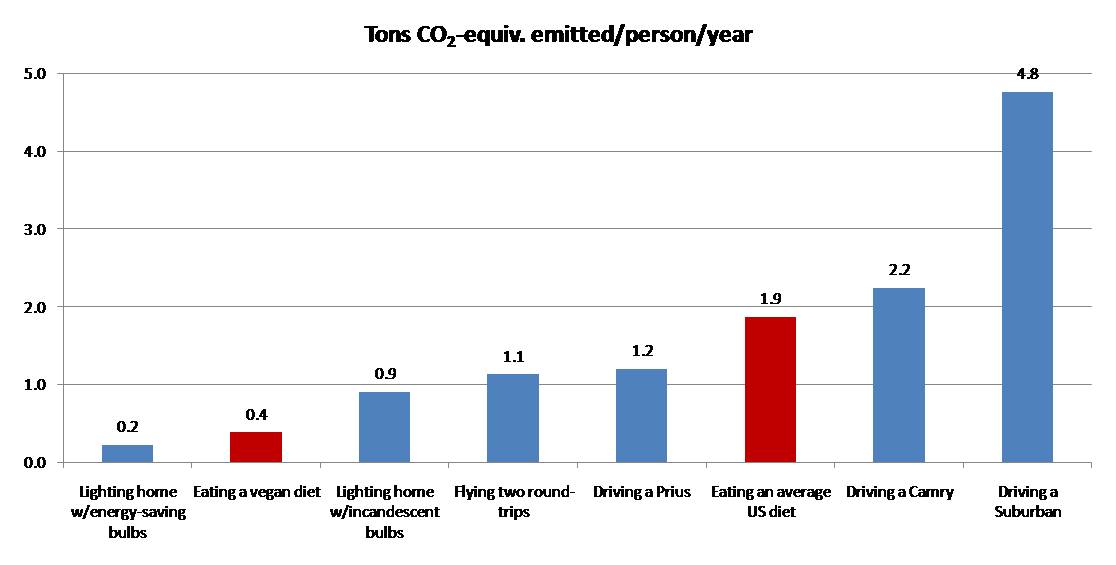
The greenhouse gas savings from replacing the average US diet with a vegan diet are pretty significant, but it’s even better to leave the Suburban in the garage.
NOTE: The emissions for flying have been corrected; in the initial version of this graph, they were listed as 1.7 tons. (11/24/09)
Sources
Diet and cars: Eshel and Martin, “Diet, Energy, and Global Warming,” Earth Interactions v.10 n.9 (2006)
Light bulbs: Fat Knowledge
Air travel: Gallup Poll 12/06 cited in Uclue and Terrapass Carbon Footprint Calculator
Cows vs. water September 25, 2009
Posted by Angelique in Animal welfare.Tags: agriculture, animal ag, animal rights, Animal welfare, cows, environment, Food ethics
add a comment
Would you rather have happy cows or clean water? Unfortunately, the Illinois EPA says you have to choose one or the other, according to a cattle farmer who shared with me his dilemma. Five years ago, this farmer’s 500 cows could move at will between the sunny pastures of outdoor exercise pens and the shade of a roofed-over concrete lot. The food bunks were in the concrete building, so the cows would come in several times a day to feed, but they spent most of their time outside – even in winter, even in snow. It might seem odd that they’d rather be scattered around in the snow than huddled up for warmth under shelter from the elements, but that was their preference, perhaps because even cold ground is easier on the hooves than a concrete floor.
Now those same cows are inside on concrete 24/7, and why? Because a creek runs a quarter-mile away from the former pasture, and the state EPA judged that the land had the potential to leak manure runoff into that waterway. Of course, no one’s going to argue that you shouldn’t protect the water supply, and manure runoff can be a very serious threat. However, according to this farmer, he walked the EPA rep right over to the creek to prove that there was no way runoff could ever reach it; when that failed to convince them, he created three different plans for runoff basins that would catch it before it would hit the stream, but that still didn’t satisfy the EPA. The only thing that did was taking all but 80 of the cows off the land and putting them in a building. (Which, by the way, he had to spend a quarter of a million dollars to build.)
Now, the EPA rep wasn’t there to give his side of the story, but let’s just say for the sake of argument that he was right – that it was impossible to both allow these animals the space and comfort of grazing on grass and keep the water safe. What kind of food system are we building, that we can’t give decent care to the environment and animals at the same time?
Book review: Skinny Bitch September 13, 2009
Posted by Angelique in Book reviews.Tags: agriculture, animal ag, animal rights, Animal welfare, book review, Food ethics
add a comment
How far a good title will take you. Even when you disavow it in the last chapter, as Rory Freedman and Kim Barnouin do in Skinny Bitch, their New York Times best-selling tirade against unhealthy food, animal cruelty, and the irresponsible government that lets it all happen. As Freedman and Barnouin state, despite repeated admonishments throughout the book to “Get Skinny” they only use the skinny thing as a ploy to get people to buy the book. They really want you to Get Vegan.
So if, as a reader, you can get over being suckered into buying a book you didn’t want to read, is it worth reading? Yes and no. If you like cardio classes taught by drill sergeant cut-the-crap types, you’ll probably like the tough-love writing style. Just be prepared that the content is entirely one-sided. The “facts” are not always facts. (For example, SB claims, “Half of all antibiotics made in the United States each year are administered to farm animals, causing antibiotic resistance in the humans who eat them.” But the link between animal antibiotic use and human resistance, though plausible, has never been proven.) The sources are too often secondary and have their own predictably extreme orientation (e.g., “Milk Sucks” from PETA.org).
Having said that, SB does effectively expose the machinations of the USDA, the EPA, and the FDA to keep the meat industry running at all costs. And the many quotes from the book Slaughterhouse are a grimly hard-hitting reminder of why this all matters in the first place. So SB may be worth a skim, with your BS radar on.
Does organic matter? September 3, 2009
Posted by Angelique in Animal welfare.Tags: agriculture, animal ag, animal rights, Animal welfare, Food ethics, organic
1 comment so far
Organic food might be better for your health (studies are trying to work that out) because it more or less prohibits pesticides from entering your food. But does it make a difference to the way animals are treated? Do animals used to make organic meat, milk, or eggs lead decent lives?
Here are the relevant conditions producers must provide to ensure animals’ health and welfare, from a summary of the USDA’s organic standards for livestock:
- Conditions which allow for exercise, freedom of movement and reduction of stress appropriate to the species
- Access to the outdoors, shade, shelter, exercise areas, fresh air and direct sunlight suitable to the species, its stage of production, the climate and the environment
- Access to pasture for ruminants
- Appropriate clean, dry bedding
- Shelter designed to allow for natural maintenance, comfort behaviors and opportunity to exercise; temperature level, ventilation and air circulation suitable to the species; and reduction of potential for livestock injury
- The producer of an organic livestock operation may provide temporary confinement for an animal because of: (1) inclement weather; (2) the animal’s stage of production
Which all sounds just peachy except for those modifiers “appropriate” and “suitable,” no doubt selected for their convenient indeterminacy. The USDA lets the producer decide what’s appropriate. Vague requirements like “access to” the outdoors and pasture mean that organic producers can (and do) raise chickens whose access to pasture consists of a shed door through which they never pass, and breeder pigs and dairy cows which are confined for most of their lives because their “stage of production” covers most of their lives. The National Organic Coalition itself has protested that the USDA standards are toothless. That pretty much says it.
Movie review: Our Daily Bread August 20, 2009
Posted by Angelique in Movie reviews.Tags: agriculture, animal ag, animal rights, Animal welfare, Food ethics, movie review
add a comment
Don’t bother turning on the subtitles for the German-language food production documentary Our Daily Bread. Hardly anyone speaks, though the constant whirring, humming, drumming, droning, clanking, and whining of the outsized machines running the show make it anything but a silent film. The film is a tribute, for better or worse, to the mechanization and implied depersonalization of the work of growing and processing food. Just the vast scale of the “inputs” – land mass, machine size, number of animals processed – is both awe-inspiring and discomfiting.
Director and cinematographer Nikolaus Geyrhalter opens the doors to the meatlocker, the greenhouse, the fish farm, the slaughterhouse, and the spookily striking salt mine, and leaves it to us to judge what’s inside. It’s up to us to discern the irony that the eggs on the conveyor belts of the henhouses are handled far more gently than the baby chicks we see at the beginning of the film, who tumble through belted waterfalls and spew out of separator chutes like so many M&Ms. There is no gratuitous cruelty – you won’t see PETA-like footage of workers kicking downed cows here. There are just machines, and efficiency, and antiseptic cleanliness. Be warned if your stomach turns easily, however, because those machines do a lot of stripping, slicing, and gutting, and plenty of animal innards are in full view.
Geyrhalter was asked in an interview if he had a hard time getting into the animal raising or processing facilities. He answered that actually many of the farms and processors he contacted were eager to share what they were doing, and you can see why – if you judge the success of a farm in terms of maintaining a controlled environment, keeping food safe, and producing massive quantities of it, these farms seemingly excel. The question is whether that’s all there is to it.
Movie review: King Corn August 18, 2009
Posted by Angelique in Movie reviews.Tags: agriculture, animal ag, animal rights, Animal welfare, Food ethics, movie review
add a comment
King Corn is a rollicking jaunt though the life of an acre of corn, or more specifically, an acre of yellow dent #2, one of the industrial varieties that make up the vast majority of the corn currently grown in the US. Aaron Woolf’s documentary kicks off with a pair of friends who are informed by a scientist at the University of Virginia that they have corn in their hair – literally, that the composition of their hair indicates that their diet is corn-based. They’re confused, because they hardly ever allow an actual vegetable to cross their plates. But what does cross their plates is lots of corn-fed hamburger meat, corn-syrup laden soda, corn-oil doused fries, etc. So Ian and Curtis plant an acre of yellow dent #2 to follow it in its journey to their stomachs, a journey which takes them from an Iowa cornfield through a Colorado cattle feedlot to a Brooklyn, NY convenience store.
Ian and Curtis are pretty laid-back protagonists, and they ensure that KC never gets preachy or depressing, even when they’re in the middle of a feedlot where the cows are sunk ankle-deep in their own shit. Their easy demeanor conceals two determined journalists, however, who score some thought-provoking interviews that are the opposite of dry documentary fodder. A couple of gems: Audrae Erickson, spokesperson for the Corn Refiners Association, whose polished and fluent explanation of why they can’t possibly visit the refinery – for their own good, of course – fits her right into the role of corporate stooge; and Earl Butz, the Nixon administration’s unapologetic driver of the current farm subsidy structure, whom you have a tough time villanizing as he powers himself down the hallway in his wheelchair, even as he praises the Age of Plenty (and plenty, and plenty more) that he ushered in.
At the end of it all, KC’s message is aptly captured by the sight of Iowa’s staggering corn mountains and the words of one of those interviewees: “We subsidize the Happy Meals, but we don’t subsidize the healthy ones.” Indeed.
Movie review: Food, Inc. August 18, 2009
Posted by Angelique in Movie reviews.Tags: agriculture, animal ag, animal rights, Animal welfare, Food ethics, movie review
add a comment
Robert Kenner’s Food, Inc. could have been the Omnivore’s Dilemma of film – the authority on the reality of our modern food production system. Instead, Kenner engineered an endictment of Big Ag, Big Government, and Corporate America that alternately illuminates and excoriates the food industry. The overzealous bits unfortunately make FI the sort of movie that exactly those people most in need of illumination will refuse to see – and the sort of movie that detractors will find easy to attack.
The merit of FI is that it manages to get movie cameras and interviewers inside some of the parts of our food chain that we never glimpse: the harsh Confined Animal Feeding Operations, the nighttime police round-ups of immigrants working in slaughterhouses, and the halls of justice where lobbyists fight laws preventing food contamination. But then come vignettes that verge on the maudlin, like the extended home movie footage of a young boy who died from E. coli poisoning, and overzealous witch hunts like the one villanizing Monsanto (to which the company released a fair response).
Overall, FI is an informative introduction to our food system if you can get past the ham-fistedness. A better option: invest the time to read The Omnivore’s Dilemma and get a more thoughtful and even-handed point of view.
Book review: The Omnivore’s Dilemma August 17, 2009
Posted by Angelique in Book reviews.Tags: agriculture, animal ag, animal rights, Animal welfare, book review, Food ethics
2 comments
If you haven’t yet read Michael Pollan’s The Omnivore’s Dilemma: A Natural History of Four Meals (aka the Foodie Bible), get your nose out of your bag of Kettle Chips and go pick it up. Books like this are made for people like you.
Pollan’s project is to trace the food chains behind four meals: the fast-food meal, the “big organic” meal, the grass-fed pastoral meal, and the hunted/gathered meal. In the process he fascinates us with descriptions of corn sex and cowpatties in a way that only someone truly in thrall to the natural world could. We shake our heads at the immense impact on our food of the minor players in the story: Fritz Haber (who invented the process for fixing nitrogen in fertilizer), Baron Justus von Liebig (who simplified soil fertility into three little letters, NPK), and Earl Butz (Nixon’s second Secretary of Agriculture, who set up the modern farm subsidy framework that enables us to eat so cheaply). We live the food chain side-by-side with Joel Salatin, hero of grass-based rotational grazing; Angelo Garro, hunter, wine-maker, and foodie extraordinaire; and #534, a steer Pollan bought to gain insight into Confined Animal Feeding Operations. To Pollan’s credit, not a single anecdote is superfluous; every character and subplot both engages and informs.
However, OD is much more than just a vivid representation of food production from many different perspectives. It is a call to action – to wake up and educate ourselves about the food we eat. Further, while Pollan refrains from urging us to use our newfound knowledge to drop our Chicken McNuggets in favor of delicacies like the Wild East Bay Yeast Levain in his hunted/gathered dinner, it’s pretty clear that he thinks that’s what anyone with any real gustatory sensibility or social conscience would do. Some call that foodie elitism; others call it good taste or good sense. A more serious critique often voiced against Pollan is that even if everyone wanted to heed his advice, only he and his Slow Food friends could afford to. And even if everyone could, does the earth have enough resources to produce food without the space-saving advantages of conventional agriculture? Pollan only lightly touches on these issues, but the virtue of OD is that it has succeeded in sparking this vital debate.
Similarly, Pollan is more suggestive than definitive when addressing the animal welfare concerns and environmental consequences of the food systems he investigates. He openly rejects utilitarianism, so he’s not in the business of meticulously weighing the costs and benefits of alternatives. This leaves the reader a bit vague about what values he’s relying on to make the judgment that we should change the way we eat. His tone hints at a mishmash of pastoral idealism, skepticism about corporate America and even capitalism itself, and (despite his disavowal) utilitarianism. If you’re looking for a more rigorous analysis of the issues that follows a strictly utilitarian calculus, Singer and Mason’s The Way We Eat, published the same year as OD, would be a better choice.
What makes OD still worth the read is precisely that Pollan is not a philosopher like Singer (or a PETA advocate, or a health nut). He’s an omnivore like most of us – who even occasionally gives in to fast food! – who has just thought a little more deeply about what we’re doing when we eat.
 From Animal To Meat