Sound and fury November 20, 2009
Posted by Angelique in Animal welfare.Tags: animal ag, animal rights, Animal welfare, Food ethics, pigs
2 comments
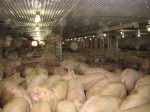
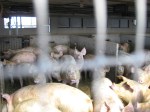
Confined Animal Feeding Operations (CAFOs) tend not to open their big meaty arms to journalists, and certainly not to those who take an interest in animal welfare. But Dan Koster, an Illinois pig farmer, was intrepid enough not only to invite me into his CAFO, but to let me publish his name. Confident that the way he raises pigs is healthy and ethical, he had no reservations about showing me around the three huge buildings on his property that house 7500 pigs destined to become pork for his main customers: Cargill, Swift, and Tyson.
Effective management is Dan’s hallmark. A panel of automated temperature and feed controls lines the hallway outside the newer buildings and links to Dan’s home office so he can keep tabs on the conditions inside. Fans along one narrow wall of the vast rectangular space pull air through the open windows on the opposite side, cooling the pigs off, and a sprinkler system adds extra insurance against overheating on the hottest summer days. The smell was surprisingly tolerable. Standing in a room with 5000 pigs around me, I could breathe easier than when I’d visited another farmer’s outdoor feedlot of just 75 pigs and was merely grateful that there was nothing in my stomach to come up.
The pigs themselves were quite clean, for the most part, as their manure drops through the slatted concrete floors of modern CAFO design. (The pigs in the oldest building were the exception. There, where the floors are partly solid, pigs were sliding around in their shit trying to get in and out of the area where they defecate. You might think that pigs wouldn’t mind that, since they tend to voluntarily slide around in mud when they live in a natural environment, but according to Dan pigs are quite fastidious about not pooping where they lie.)
I asked about lameness, a common issue in CAFOs because our ingenuity in genetic manipulation has not yet extended to creating animals whose joints tolerate concrete. However, Dan said very few of his pigs, perhaps a tenth of one percent, suffered from lameness, and from my observation that seemed a fair estimate. Not that I could see the actual legs of the pigs – they were packed too closely to discern much more than a sea of backs – but I could see the shuttling lines of bodies as the movement of one necessitated the movement of the next in the crowded space. Dan estimated the concentration of pigs as one per every 7.5 square feet, which gives them plenty of room to run around when they are just-weaned piglets, and room to do nothing but press against the next pig when they get close to their market weight of 260 pounds.
In sum, the smell pleasantly underwhelmed me. The sight was pretty much as expected. What shocked me was the sound. Opening the door into the confinement pen was like walking into the engine of a 747. That is, a squealing, panicked, urgent 747. So below, along with a few pictures (sorry for the spots, in the semi-darkness I didn’t realize my lens was dirty!) I’ve included a link to a 45-second audio clip of us entering the building. We opened the door about 15 seconds into the clip. If anyone has a description that can more adequately describe the sound, please comment; I’d be curious to hear it.

Lorentz Meats November 13, 2009
Posted by Angelique in Animal welfare.Tags: animal ag, animal rights, Animal welfare, cows, Food ethics, organic, slaughterhouses
add a comment
My article for Heavy Table explains why people who care about animal welfare and those who just want to avoid poop in their food should take a look at the example set by Lorentz Meats.
Will somebody please take this job? November 6, 2009
Posted by Angelique in Animal welfare.Tags: animal ag, animal rights, Animal welfare, Food ethics, slaughterhouses, veal
6 comments
Last week the Humane Society released another stomach-turning expose of the food animal industry. It’s an undercover video of a slaughter plant in Vermont that specializes in “bob veal,” which is veal from young (as in, a few days old) calves. The video goes beyond the predictably horrific. My personal favorite part is at the end, when the onsite USDA inspector who is supposed to ensure proper animal handling is giving a little friendly advice to the undercover agent. The agent, who had been hired into the plant as a floor cleaner, had called the attention of the workers and inspector to the fact that a calf on the assembly line was still moving. Afterward, the USDA inspector tells the agent, “You did the right thing…but next time just tell Frank or Terry. ‘Cause that’s something I’m not supposed to know. I could shut them down for that.”
Which reminds me that the US Department of Agriculture is just that – the department of agriculture. It is not the department of animal welfare, or even the department of consumer protection. Its mandate is primarily to support the agricultural industry, a fact which is evident when you read its strategic plan. Somewhere in the middle of that plan the USDA mentions food safety, and at the end it throws a bone to land protection. Nowhere does it discuss animal treatment, so we really shouldn’t expect that the USDA would concern itself with it.
The question is, if companies have no incentive to protect animal welfare, and the USDA has no incentive to protect animal welfare, then who does? People who care about animal welfare, presumably. That includes members of the Humane Society and similar organizations, but also regular Joes and Janes who prioritize animal welfare when they purchase (or choose not to purchase) animal-based products. So, how can we ensure that these people, who have an incentive to protect animal welfare, can actually protect it when it’s threatened, say in the environment of the farm or the slaughterhouse? The best answer is by giving them visibility into those places. Frankly every farm and slaughter facility should have webcams feeding sites where anyone who chooses can observe their activities. This is nearly but not completely unheard-of; some slaughter facilities already have cameras that feed Intranet sites that their customers log onto to observe how their own animals are handled.
The second-best solution is for trusted third-party organizations to have this sort of visibility, if businesses are uncomfortable granting it to the general public. Companies that want to market their meat with certain certifications – say, Animal Welfare Approved, or Food Alliance certified – are already opening up their doors to these organizations for inspections. However, there is no certification of which I’m aware that covers the entire lifecycle of an animal, from farm to table. Most certifications cover only farms [BUT see comment to ths post from Beth at the Animal Welfare Institute – 11/7/09]. Food Alliance covers processors (in the meat industry, the euphemism for slaughterhouses), but separately from farms, so the fact that a product is labeled as Food Alliance certified does not guarantee both. And no one certifies transportation from farm to slaughterhouse to protect animal welfare during that process.
Who will step up to the plate to solve this problem?
Movie review: Fresh November 3, 2009
Posted by Angelique in Movie reviews.Tags: agriculture, animal ag, animal rights, Animal welfare, Food ethics, movie review, organic
add a comment
The movie Fresh didn’t achieve wide release. That means it relies on volunteers to host screenings and prospective viewers to do a little legwork to find one. As a result, the only people likely to see the movie are those who are already converted to its cause of healthy, local, sustainable food. Accordingly, the screening I attended was patronized by about 200 enthusiasts of all things local and family-farm produced, and was preceded by a light local-food dinner – sustainably-raised pulled chicken sandwiches and 100% grass-fed beef hotdogs.
In a nutshell, Fresh is a celebration of the locavore movement and its heroes. If you’ve read Omnivore’s Dilemma or seen Food, Inc. you won’t find any new facts or surprising revelations in this film, but if you’re a locavore in the mood for a morale-boost (and who isn’t sometimes) you will enjoy it. Extensive interviews with OD author Michael Pollan, sustainable farmer Joel Salatin, and urban farming advocate Will Allen inspire an outpouring of “yes we can” sentiment which doubtlessly everyone sitting with you in the theater will share. Just don’t expect any critical discussion or penetrating analysis of the arguments for and against the movement. That’s OK. It’s not the first movie that asks you to suspend judgment for an hour and a half and just enjoy yourself.
Climate chicanery October 30, 2009
Posted by Angelique in Global warming.Tags: animal ag, carbon footprint, climate change, cows, Food ethics, Global warming
8 comments
More fodder for global warming skeptics comes from a report by two World Bank affiliates in the November-December issue of World Watch. The article, “Livestock and Climate Change,” does not deny the reality of global warming or the role of livestock in accelerating it, as presented in the 2006 UN Food and Agriculture Organization’s report Livestock’s Long Shadow. Rather, authors Goodland and Anhang assert that the UN FAO report, which is the definitive study of this topic, understates the volume of livestock greenhouse gas (GHG) emissions by a whopping 400%. Which makes the climate change researchers at the FAO – and people like me who have relied on their analysis – look like idiots.
But if the FAO report really is massively wrong, out the truth must come, regardless of the resulting damage to the credibility of climate research. So, are Goodland and Anhang courageously exposing a botched analysis, or disingenuously furthering the anti-meat cause with a botched analysis of their own?
First, the sniff test. Goodland and Anhang’s revised GHG estimates imply that livestock are responsible for 51% of anthropogenic global warming! Really, with all our heavy manufacturing in industries from construction to apparel? And all the clever ways we move without actually moving, from elevators to 747s? And all the heating and air conditioning that leaks out our doors and windows? And the long showers and the dishwashers? And (let’s not forget) all that breathing we do? Over half of our emissions come just from livestock? Intuition is not in Goodland and Anhang’s favor.
But let’s dig into the science. Their first point is that the FAO estimates don’t include livestock breathing as a source of CO2 emissions. True, and the FAO isn’t as clear as it could be on why they shouldn’t be included. Stephen Walsh provides an accessible explanation: “the normal fate of a plant is to make way to new plants by dying, decaying and releasing the carbon it absorbed from the atmosphere back to the atmosphere mostly as CO2. Whether the release of CO2 is facilitated by a large animal’s digestive system or by insects and bacteria in the soil doesn’t matter.” In other words, livestock breathing is just one way plants release carbon in their normal life cycle. If the livestock didn’t exist, plants would do it on their own. (Here is Walsh’s full analysis.)
And if you did think that livestock breathing emissions should be added back into total emissions, you should also add human breathing emissions back in. So when Goodland and Anhang conclude that livestock emissions are 51% of anthropogenic emissions, they are conveniently neglecting another major source, thereby incorrectly inflating the proportion that comes from livestock.
Next the authors tackle land use. They acknowledge that the FAO counts emissions from converting land from forest to livestock use, but say the estimate is too low because it doesn’t count emissions from all the pre-existing land used to support livestock, which could instead be used to grow climate-friendly biofuels. That’s like saying we should count my bathroom floor as a GHG emitter, because I’m not currently growing biofuels on it. Nutty.
Then the authors get into the tricky business of trying to figure out how to appropriately convert units of methane, which is a GHG released by livestock as they burp, fart, and poop, to CO2-equivalent units. (Emissions of different gases have to be converted to CO2-equivalent units so they can be added together to get a picture of total emissions.) Methane is a far more potent GHG than CO2, but CO2 lasts much longer in the atmosphere. Therefore, the shorter the timeframe you choose to analyze, the worse methane emissions look relative to CO2. Goodland and Anhang suggest that instead of using the 100-year timeframe proposed by the FAO, we analyze emissions over 20 years. This triples how bad methane emissions look once they’re converted to CO2-equivalent units. Here, neither the FAO nor the authors is correct, and neither is incorrect. The choice of timeframe is subjective – if you’re interested in short-term effects of emissions, you’ll choose a shorter timeframe, and if you’re interested in impact over several generations, you’ll choose a longer timeframe. Certainly it’s disingenuous to suggest, as the authors do, that the FAO understates emissions. The FAO is just studying a longer timeframe.
Then the authors have the nerve to avoid recalibrating methane emissions from non-livestock sources as they did for livestock, saying it requires “further work.” So, just as they did with livestock breathing emissions, they inflate livestock methane emissions but conveniently neglect to inflate non-livestock methane emissions. Then of course the percent of emissions from livestock looks astronomical.
Finally, the authors have a catch-all “other” category for miscellaneous emissions they claim the FAO understates. The rationale for increasing the estimates of these “other” categories is often that the FAO is using old information – from the 1990s and early 2000s, mostly. But we know that livestock inventories have increased since then, so we know livestock emissions must have increased too, the authors argue. Yes. And, I would add, we also know that the Chinese are driving a hell of a lot more cars, so emissions from the automotive category should increase. And flying more, and consuming more imported designer clothes… Again, if you’re going to increase livestock emissions to more accurately capture what’s happening in the year 2009, you have to increase all these other categories of emissions as well. But Goodland and Anhang don’t, and that’s why they come up with the eyeball-popping and totally false conclusion that over 50% of current GHG emissions come from livestock.
In sum, we already knew that eating meat was a big driver of global warming. No need to bolster the case with inflated numbers and trumped-up analysis. But thanks, Goodland and Anhang, for making climate change research an easy target for all those naysayers out there.
Chick, chick October 23, 2009
Posted by Angelique in Animal welfare.Tags: animal ag, animal rights, Animal welfare, chickens, Food ethics
1 comment so far
About six weeks ago, I wrote a post on the killing of male baby chicks in the chicken industry. I lamented the fact that since male chicks have unappetizing meat and can’t lay eggs, all except the few who become breeders are killed after birth. Soon afterward, the charity group Mercy for Animals published an undercover video showing exactly how this is done in many hatcheries: by putting live chicks through a grinder.
Coming from an organization with the name Mercy for Animals, it’s no secret what the purpose of this video is – to make chicken production so physically and morally revolting that people will trade in their McNuggets for McVeggies. However, the agricultural industry newspaper AgWeek published an interesting rebuttal to the video claiming that the chicks, after all, die instantly in the grinder. A welfare scientist with the American Veterinary Medical Association (AVMA) commented that “public revulsion … could force a shift to techniques that would be worse for the animals. Gassing male chicks, for example, might appear more humane, but chicks are resistant to the sedative effects and might suffer more…”*
Of course, reading all this I couldn’t help but engage in exactly the sort of anthropomorphism you’re supposed to avoid, and imagined myself shoved down the inverted cone of a grinder – feet first of course, Saw-fashion, to make it last. But that’s exactly the AVMA’s point: this imagined scenario doesn’t come close to what it’s like for the chicks, so anthropomorphizing is a waste of time, and what’s more, might incline one to make a decision that’s actually worse for the animals. Watching the video myself, I had to admit that the rate at which chicks were going through the grinder seemed to ensure that they were killed in no more than one or two seconds. Less fortunate were the chicks who fell through the cracks between conveyor belts and survived, maimed, scorched, and irrelevant to a business which has zero incentive to do the decent thing and grant them a quick death.
*N. Duara, “Hatchery Video a Reality Check for Some,” AgWeek (September 14, 2009): 27.
Even happy cows poop October 16, 2009
Posted by Angelique in Global warming.Tags: animal ag, carbon footprint, climate change, cows, environment, Food ethics, Global warming, organic
9 comments
Thousand Hills Cattle Company is huge on the Minneapolis organic/local/sustainable food scene. If you’ve been here and eaten any part of a cow at one of those restaurants whose menu lists where its food comes from, it was probably from Thousand Hills. The company distributes beef from Upper Midwest family farms which pasture their cattle for their entire lives, contrary to the conventional industrial practice of “finishing” them in confined feedlots. At a recent screening of the movie Fresh, the owner, Todd Churchill, gave a speech about why he’s such a proponent of keeping cows on pasture.
Todd extolled the many virtues of pastured beef for human health, animal welfare, and the environment. It’s hard to argue with his view that raising animals on pasture is better than keeping them in confinement, but one of his claims struck me as a bit disingenuous. “Who has heard,” he asked, “that you should be a vegetarian if you care about global warming?” Several people in the audience, including myself, raised their hands. “Well,” said Todd thoughtfully, “that’s true if you’re talking about industrial cattle production. But what’s the energy source for my farmers’ cattle?” An audience member dutifully raised his hand and called out: the sun. “Yes,” said Todd, “that’s right – we feed our cows on grass that uses the sun’s energy. We don’t fertilize and till grain. We use almost no tractors.“ So, the implication was, if you just stick to grass-fed beef you avoid all those nasty chemicals and pollutants that are cooking the earth. No need to give up those burgers.
Is it true that eating pastured beef is just as good, from a global warming perspective, as being a vegetarian? Well, if the aspects of beef production that cause global warming are the fertilizer and tractors that go into it, then eliminating them would make eating beef climate-friendly. If not, we have a problem.
Here’s the breakdown of the sources of livestock emissions from the UN Food and Agriculture Organization’s 2006 report Livestock’s Long Shadow.*
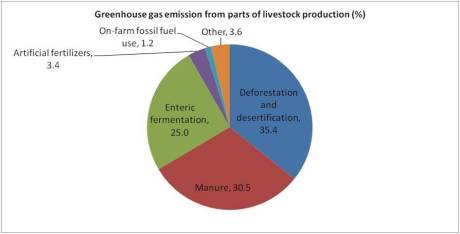
Houston, we have a problem. Turns out only about 4.5% of livestock greenhouse gas emissions come from fertilizers and on-farm fuel use (e.g., to run tractors). The biggest portion – over 35% – is due to deforestation and desertification, which happens when forest or other virgin land is cleared to provide space to graze animals. Now, to be fair to Todd, if the farmers he works with are using existing grassland rather than clear-cut forests to graze their cattle, they aren’t contributing to greenhouse gas emissions in that way. So add that to the savings from forgoing fertilizer and tractors and they are cutting emissions about 40% by raising cattle on grass.
But two other categories of emissions kind of smack you in the face when you look at that UN pie chart – the emissions from manure (pooping) and enteric fermentation (burping and farting). No, this isn’t the burping and farting that the guys on the tractors do while they’re bouncing along the prairie; this comes from the animals and as such is not eliminated in Todd’s world of happy cows on pasture. Again, I’ll give him the benefit of the doubt and shave 9% off because certain emissions happen when poop that’s been deposited on the ground gets leached or eroded away, and according to the UN that’s negligible for grassland. So Todd has saved 49% of emissions farming his way, which leaves 51% of livestock emissions still there, even in his relatively clean system. His cows may be happy, but they still poop. Score one point for the vegetarians.
*Pie chart is from UN FAO as quoted in McMichael, Powles, Butler, and Uauy, “Food, Livestock Production, Energy, Climate Change, and Health,” The Lancet 370 (October 6, 2007): 1258. Information is for all livestock, not just cattle, but cattle are worse than average emitters of greenhouse gases. Therefore using these numbers understates their emissions.
Munching your way to a hotter climate? October 8, 2009
Posted by Angelique in Global warming.Tags: agriculture, animal ag, carbon footprint, climate change, environment, Food ethics, Global warming
5 comments
There’s never any good news about climate change. Not only is it always getting worse – happening faster than we’d thought, wreaking unimagined levels of havoc – but everything we do seems to contribute to it. Why bother changing your light bulbs when your daily commute could illuminate your whole neighborhood? And if you thought driving a car was bad – well, you could drive clear across the planet with the greenhouses gases your Thanksgiving flight home will release. And flying is nothing compared to the damage you’re doing every time you eat a burger!
Reasoning that everything can’t literally be worse than everything else, I did a little research and composed a ranking of our actions’ impact on greenhouse gas emissions, and where meat-eating falls on that list. This ranking is rife with assumptions, but see the chart below for my best shot at the average person’s annual CO2 emissions from various sources.
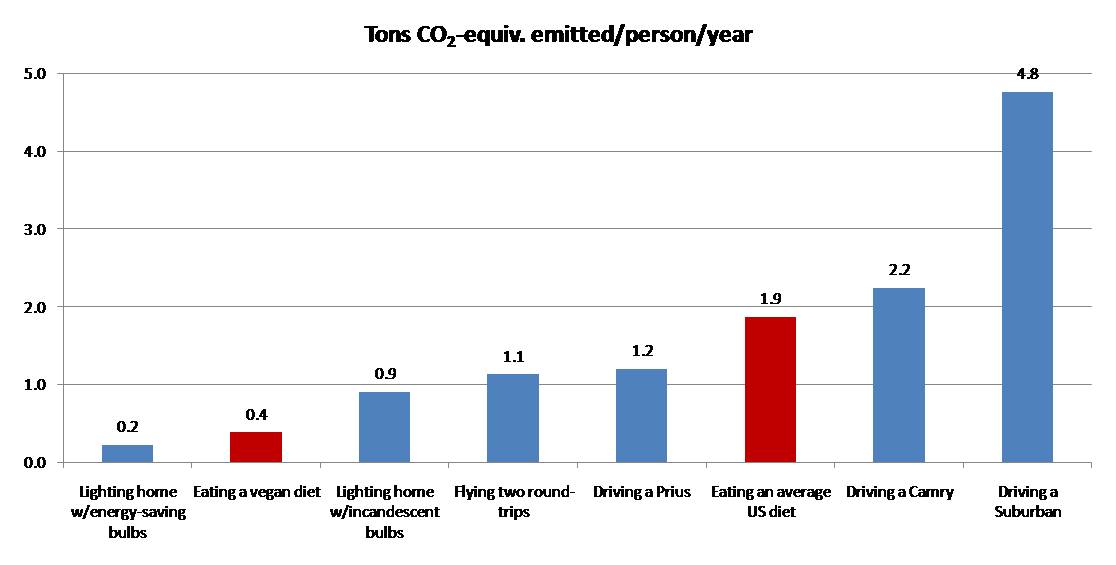
The greenhouse gas savings from replacing the average US diet with a vegan diet are pretty significant, but it’s even better to leave the Suburban in the garage.
NOTE: The emissions for flying have been corrected; in the initial version of this graph, they were listed as 1.7 tons. (11/24/09)
Sources
Diet and cars: Eshel and Martin, “Diet, Energy, and Global Warming,” Earth Interactions v.10 n.9 (2006)
Light bulbs: Fat Knowledge
Air travel: Gallup Poll 12/06 cited in Uclue and Terrapass Carbon Footprint Calculator
Slaughterhouse curiosities October 1, 2009
Posted by Angelique in Animal welfare.Tags: animal ag, animal rights, Animal welfare, cows, Food ethics, slaughterhouses
3 comments
Visiting two slaughterhouses in southern Minnesota over the past couple of weeks has left me with a number of weighty issues to address. However, I thought I’d start off with just a few curiosities.
- Body parts continue to move for a very long time after they’ve been separated from their host. At the facilities I visited, what’s called the kill floor was separated into four stations – one where the animal is stunned, bled out, and trimmed of the head and feet; one where it is skinned, eviscerated, and quartered; one where the small organs are dealt with; and one where the quartered carcass is hosed off. It took about a half hour for an animal to move through all those stages. At one point the person cleaning and separating the small organs that could be sold, like the liver, left her station for a moment. I went over to take a closer look at her handiwork and saw a loosely triangular whitish-pink blob on the stainless steel worktable. This was a cow’s tongue. And it was quivering, probably twenty minutes or so after its previous owner had been killed.
- The outsides smell a lot worse than the insides. The room attained its olfactory nadir when a particularly dirty cow – one whose coat was covered with mud and dung – entered the stunning chamber. It was a relief to finally get the skin off and thrown into a rubber trash can for disposal. Otherwise, there wasn’t much to smell.
- No one wore gloves. Perhaps I expected them to because I’m used to seeing food handlers at various fast food establishments don gloves (and then use them to touch not only my food, but my money, the cash register, and whatever other disease-carriers are within arms’ reach) but these folks dug bare-fisted and elbow-deep into carcasses to drag out the organs.
Cows vs. water September 25, 2009
Posted by Angelique in Animal welfare.Tags: agriculture, animal ag, animal rights, Animal welfare, cows, environment, Food ethics
add a comment
Would you rather have happy cows or clean water? Unfortunately, the Illinois EPA says you have to choose one or the other, according to a cattle farmer who shared with me his dilemma. Five years ago, this farmer’s 500 cows could move at will between the sunny pastures of outdoor exercise pens and the shade of a roofed-over concrete lot. The food bunks were in the concrete building, so the cows would come in several times a day to feed, but they spent most of their time outside – even in winter, even in snow. It might seem odd that they’d rather be scattered around in the snow than huddled up for warmth under shelter from the elements, but that was their preference, perhaps because even cold ground is easier on the hooves than a concrete floor.
Now those same cows are inside on concrete 24/7, and why? Because a creek runs a quarter-mile away from the former pasture, and the state EPA judged that the land had the potential to leak manure runoff into that waterway. Of course, no one’s going to argue that you shouldn’t protect the water supply, and manure runoff can be a very serious threat. However, according to this farmer, he walked the EPA rep right over to the creek to prove that there was no way runoff could ever reach it; when that failed to convince them, he created three different plans for runoff basins that would catch it before it would hit the stream, but that still didn’t satisfy the EPA. The only thing that did was taking all but 80 of the cows off the land and putting them in a building. (Which, by the way, he had to spend a quarter of a million dollars to build.)
Now, the EPA rep wasn’t there to give his side of the story, but let’s just say for the sake of argument that he was right – that it was impossible to both allow these animals the space and comfort of grazing on grass and keep the water safe. What kind of food system are we building, that we can’t give decent care to the environment and animals at the same time?
 From Animal To Meat